
IDOC Releases for Boise County
The Idaho Department of Correction is a statewide corrections system, not a Boise County facility. None of its prisons is in Boise County. A person sentenced in Boise County can be assigned wherever IDOC determines, so a guessed institution near the City of Boise is not a sound search method. Start with the statewide resident and client search. The record follows the person across institutions, parole, probation, and discharge.
An IDOC prison release may lead to community parole, another detaining authority, or eventual sentence discharge. Parole is conditional release before sentence satisfaction. Probation is court-ordered community supervision. Discharge means the sentence has been satisfied. A transfer between prisons is not release, and a grant to a detainer can end IDOC confinement while another custodian receives the person.
Confirm an IDOC Release
The IDOC resident and client search accepts a name or IDOC number. Names can vary, and IDOC warns that one person may have more than one ID number. Compare full name, birth information, sentencing county, case data, and every plausible ID before declaring a match.
- Search by IDOC number when known, or enter the legal name.
- Open each plausible detail record and confirm Boise County in the sentence information.
- Read the overall status before the sentence rows.
- Compare PED, sentence satisfaction date, next hearing, and released-to-supervision fields by label.
- Record the data-current time and verify a recent change with IDOC.
“In custody” supports current IDOC confinement. “In community” supports a community status, but the sentence row should show whether it is parole or probation and when release to supervision occurred. “Discharged [date]” is the strongest public IDOC signal that the sentence was satisfied. After discharge, IDOC preserves the person's name and discharge date but suppresses conviction details, creating a useful historical boundary.
IDOC Records and Contact
The statewide search is the first route for custody, community status, and discharge. IDOC directs inaccuracies or requests for added basic information to Records Information. Exact individual-photo availability, a dedicated form URL, and fees were not confirmed, so request an estimate and do not promise that a photo or protected field will be released.
Idaho Department of Correction1299 N. Orchard Street, Suite 110
Boise, ID 83706
208-658-2000
A focused request should identify the complete name, IDOC number, and record type. Ask for existing nonexempt custody or release information rather than asking the agency to calculate or certify a new narrative. If a Commission decision is needed, use the Commission's public decisions page or request the specific Notice of Action Taken by hearing date and IDOC number.
IDOC Sentence Date Labels
Idaho's unified sentence contains a fixed, determinate minimum followed by an indeterminate term. Under Idaho Code §19-2513, ordinary parole eligibility follows the fixed term. PED is the parole eligibility date, not a promised exit. A next parole hearing date shows when review may occur. A Commission TPD is a tentative parole date dependent on programming, release-plan approval, paperwork, detainers, and later action.
| Label | Meaning |
|---|---|
| PED | Earliest ordinary parole eligibility after the fixed term. |
| TPD | Conditional Commission target, not completed release. |
| Released to Supervision | Date custody shifted to community parole or probation. |
| Sentence Satisfaction Date | Calculated sentence-completion field. |
| Discharged | IDOC sentence satisfaction status with date. |
There is no verified blanket Idaho rule requiring a simple 85-percent calculation. Modern IDOC sentences do not receive routine behavioral good time during the fixed term. Section 20-101D concerns narrow extraordinary meritorious acts, not a standard deduction.
IDOC Parole Release Proof
The Commission's weekly schedule shows that a hearing is set. Its later Notice of Action Taken reports the decision and may list a TPD, comments, or another hearing. Outcomes include grant, deny, continue, reinstatement after revocation, and passage to full-term release. None proves the later physical exit by itself.
The reliable sequence is schedule, decision, then the current IDOC detail. A parole grant can be rescinded, delayed for programming, held for plan approval, or granted to a detainer. Check the later overall “In community” status, sentence-level “Parole,” and “Released to Supervision” date. When a detainer is named, obtain the receiving agency from the movement record.
The successful IDOC source image below shows the statewide search used for Boise County commitments.
View the official IDOC search.
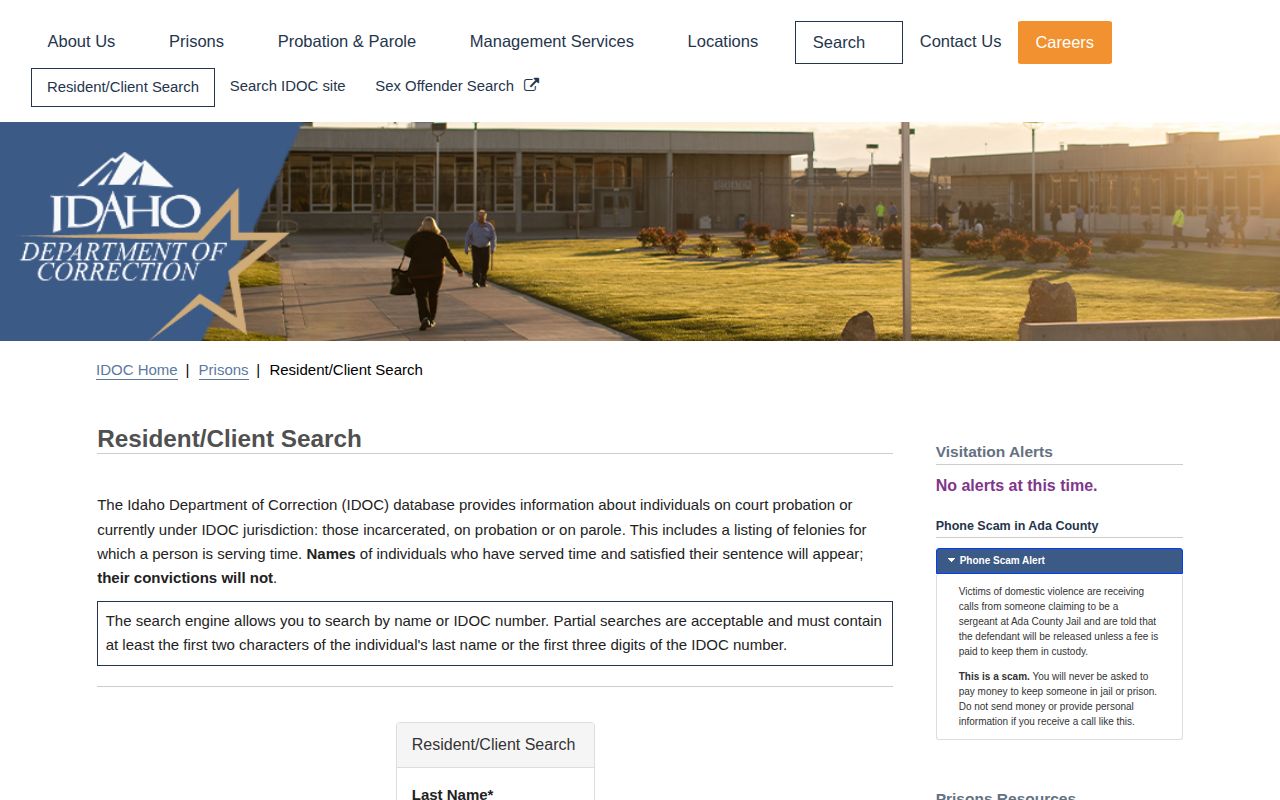
The search is statewide because sentencing county does not establish the current prison.
Boise IDOC Community Supervision
IDOC supervises felony parole and probation. Boise County generally falls within District 4, which serves Ada, Boise, Elmore, and Valley counties, but the actual district shown on the person's current record controls. Sentencing county does not guarantee the present reporting office after a move.
IDOC District 410221 W. Emerald Street
Boise, ID 83704
208-327-7008
An “Active Bench Warrant” status is not ordinary community supervision and not discharge. Verify it directly. Boise County Community Justice is a separate local office for pretrial services and adult misdemeanor probation; it is not the state felony parole office. Keeping those systems apart prevents a local misdemeanor obligation from being attributed to IDOC parole.
IDOC Versus Boise Jail Release
A Boise County arrest can lead to an Ada County Jail booking under the county's housing arrangement. Disappearance from Ada's current roster may mean transfer into IDOC, not community release. Search IDOC and request Ada's receiving-agency field when the transition is unclear. Boise County records may explain the arrest and transport, while Ada owns its physical booking and movement entries.
A county jail sentence uses the judgment, jail credit, and jail calculation. Do not apply IDOC parole labels or prison good-time assumptions. Federal and immigration custody also use separate locators. The statewide IDOC record answers only the custody and supervision events that belong to IDOC.
When a recent IDOC result conflicts with a court order or parole notice, compare the date each source was created and the question it answers. The court supplies legal authority, the Commission supplies its parole action, and IDOC supplies the later custody or supervision status. Preserve those roles in the verification note. If the statewide record has not updated, contact IDOC with the person's number and ask about the exact nonconfidential status field rather than guessing from the planned date.
The Boise County released inmate search provides the full cross-custodian route when the holding system is unknown. Note: Roster absence is a search clue, not release proof.