
Boise Release Dates Explained
A scheduled date answers when release might occur under the current record. Actual release answers when the named custodian ended physical custody and what happened next. Those facts can diverge. A court may authorize release, the Commission may set a tentative parole date, or IDOC may calculate a sentence milestone, yet a detainer, pending plan, new order, or transfer can prevent community release.
A person awaiting trial has no sentence-based release date. Bond may allow release, but another hold can remain. A person serving a county jail sentence needs the judgment, credited jail time, and the jail's calculation. A state prisoner needs the IDOC sentence record. Start with the custodian because county jail, state prison, federal prison, and immigration detention use different date systems.
- PED
- Parole eligibility date, normally the point when ordinary parole consideration can begin after fixed time.
- TPD
- Tentative parole date set by the Commission, subject to conditions and later action.
- Sentence Satisfaction Date
- The IDOC date associated with completion of the sentence calculation.
- Released to Supervision
- A recorded shift from confinement to community parole or probation supervision.
Find Boise Inmate Release Dates
Boise County does not supply one universal release-date search. People arrested locally may be held at Ada County Jail under the housing arrangement. A felony commitment can be assigned anywhere in IDOC. Identify the physical custodian before reading a date, and reconcile the full name, birth information, booking or IDOC number, case number, and sentencing county.
- Check Ada County's current roster for a local jail booking. Its daily update can lag and it is not a released-person archive.
- Search the IDOC resident and client search for a state sentence. Open every plausible ID because IDOC warns that a person may have more than one number.
- Read PED, Next Parole Hearing Date, Sentence Satisfaction Date, status, and sentence rows together. Do not rename PED as an exit date.
- Review the Boise County iCourt case for the judgment, sentence, credits, and later orders. Court authority still does not prove the physical exit time.
- For a county sentence, ask the jail or records custodian for the release calculation. For parole, compare the Commission decision with later IDOC status.
When Ada physically booked the person, its release or movement record is the best source for the exact time Ada custody ended. Boise County Sheriff's Office may hold the arrest and transport record. If the date belongs to a state sentence, IDOC is the calculation source. A BOP or ICE case requires the system-specific locator, not an Idaho state estimate.
Boise IDOC Release Date Fields
IDOC search results distinguish custody from community status and discharge. Sentence rows can display the offense, county, type of supervision, start and satisfaction dates, and a PED. A person may have consecutive or concurrent sentences. Consecutive terms run one after another, while concurrent terms overlap. The controlling calculation may therefore differ from a quick reading of one sentence row.
The public search screen below is the official starting point for a Boise County felony commitment. It supports name or ID-based matching and leads to the detailed sentence record.
Open the IDOC resident and client search.
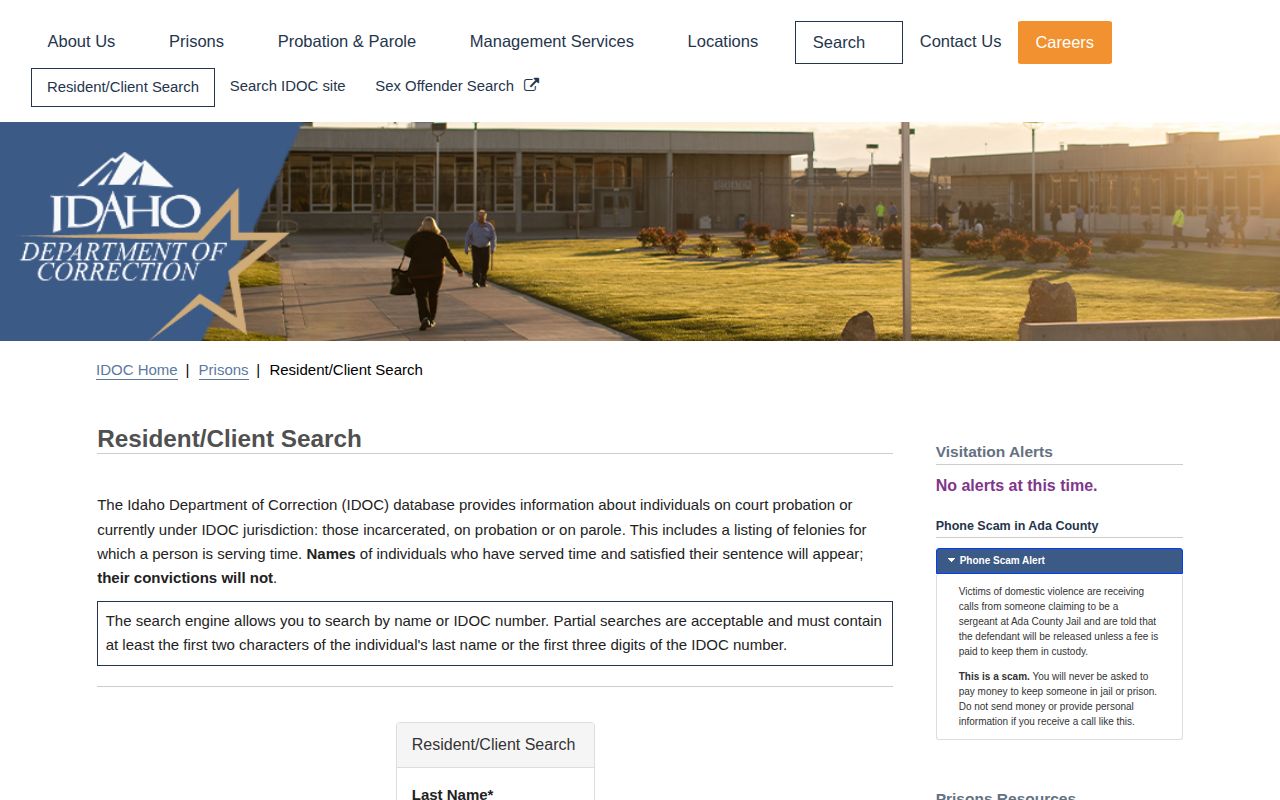
The search result must still be matched by identifiers and sentencing county before its release-date fields are attributed to a Boise County case.
An “In community” result is stronger evidence of community placement than a planned date. At sentence level, “Parole” or “Probation” and “Released to Supervision” identify the type and timing of community supervision. “Discharged [date]” is different: it reflects satisfaction of the state sentence, and IDOC suppresses conviction detail after discharge while preserving name and discharge date.
Idaho Fixed-Term Release Rules
Idaho uses a unified sentence. Under Idaho Code §19-2513, the judge sets a fixed, or determinate, portion followed by an indeterminate portion. The fixed term is the minimum period of confinement for ordinary parole purposes. PED ordinarily marks the start of eligibility after that fixed portion. It is not a date on which release must occur.
During the minimum term, ordinary parole, discharge, or a routine good-conduct reduction is unavailable. Narrow mechanisms can apply, including medical parole or the meritorious-service law. The Commission controls parole, while IDOC calculates and supervises the sentence record. A hearing date shows that review is scheduled. A decision may set a TPD, but the Commission describes that date as tentative and dependent on programming, plan approval, and other conditions.
County jail time is different. Use the filed judgment, the court's jail-credit ruling, and the jail's own calculation. No official Boise or Ada County good-time formula or weekend-release policy was confirmed in the research. Request the calculation rather than importing prison parole rules into a local jail sentence.
Why Boise Release Dates Change
A date can move because the underlying legal or administrative facts changed. It can also appear to move when a user compared unlike fields, such as PED and sentence satisfaction. Verify the field label, data-current time, and sentence row before concluding that IDOC recalculated a date.
| Factor | Possible effect | Best confirmation |
|---|---|---|
| Sentence structure | Consecutive or concurrent terms change the controlling calculation. | IDOC sentence rows and judgment |
| Court credit or order | Credited custody time or a revised judgment changes computation. | Filed court order and custodian |
| Parole action | A grant, denial, continuance, rescission, or revocation changes the path. | Commission decision and later IDOC status |
| Program or plan | A TPD may remain unmet until required work and release planning are approved. | Commission comments and IDOC |
| Detainer or new case | Another authority may receive the person instead of a community release. | Movement record and receiving agency |
| Administrative recalculation | The displayed date may change after legal or records review. | Current IDOC record |
A detainer is a request or authority for another agency to hold or receive the person. It may produce a transfer on the planned date. A parole grant can work the same way when the Commission grants release to a detainer. In both cases, the prior custodian's release record does not establish freedom in the community.
Confirm Boise County Release
Use a sequence of sources. For parole, first read the Commission schedule, then the Notice of Action Taken, and finally the later IDOC detail. The notice can report a grant or TPD. Only the later “In community” and “Released to Supervision” fields support that the state prison custody phase actually ended in community supervision.
For Ada jail custody, confirm current status by phone at 208-577-3000 and request the written movement record when exact time, release type, or destination matters. ACSO records can show its physical release. Boise County records can show the local arrest and transport. If the legal reason is disputed, compare both with the Boise County court docket.
A written Ada request should identify the person, booking episode, and date range, then ask for the booking sheet and chronological custody, movement, and release entries. Specify effective release date and time, release authority or type, and the receiving agency or destination if the event was a transfer. Ask for electronic delivery and a cost estimate. Ada describes an ordinary response period of three to ten business days, but that is not a promise that every requested field is public or already exists.
Boise County Records requires a specific written request and will not provide record information by telephone. Ask for the nonexempt records sufficient to show local arrest, holding, transport, and custody movements. When the two agencies split ownership, submit focused requests to both rather than asking either office to create a narrative. A “no responsive records” answer can mean the wrong custodian was asked, not that the custody event did not occur.
A VINELink Release Check can send a prospective custody alert, but treat it as corroboration. Record the named agency and event wording, then verify against that source. A missing roster result, court order, parole grant, or VINE event alone is not enough.
No Idaho 85-Percent Formula
No verified Idaho law creates a blanket rule that every modern prisoner serves 85 percent of a sentence. Applying that percentage to a Boise County sentence can yield a false date. Idaho's defensible baseline is the court-set fixed term, subject only to narrow lawful exceptions, followed by eligibility and Commission review where parole applies.
Idaho Code §20-101D is not routine behavioral good time. For modern crimes, it permits a limited reduction for extraordinary meritorious acts, such as heroism risking life or outstanding service that saves lives, prevents major riot property loss, or prevents escape. The statute includes limits and withdrawal authority. It should not be turned into a standard release-date deduction.
An older credit schedule applies to offenses committed before July 1, 1986. It must not be applied to a current sentence. For modern cases, do not subtract a generic percentage, promise parole at PED, or treat TPD as final. Read the current record and ask IDOC or the jail for the actual computation.
The parole record adds another timing layer. The Idaho Commission of Pardons and Parole posts hearing schedules and later Notices of Action Taken. A notice may grant parole, deny it, continue the matter, set another hearing, or establish a TPD. Even a grant can be contingent on programming, an approved plan, paperwork, or a detainer. The hearing and notice explain Commission action, while the later IDOC record answers whether custody actually shifted to supervision.
For probation, distinguish a community sentence from release after prison. Courts order probation, and IDOC supervises felony probation and parole. A sentence-level “Probation” entry or “Released to Supervision” date can help, but the current supervising district shown on the record controls. Boise County sentencing does not guarantee that District 4 remains the person's reporting office after a move. A status such as “Active Bench Warrant” is not ordinary discharge and should be verified directly.
Note: A calculation is only as current as the sentence, credit, hold, and agency data used to produce it.