
Boise County VINELink Coverage
VINELink is the public interface for Idaho VINE, an automated custody-notification system. Idaho Department of Correction movement and status coverage is documented. A user can search one person, open the matching subject record, and review the reporting agency, custody status, location, and event date. The service can also send notice when that agency reports a qualifying change. It is a prospective alert tool, which means it is designed to notify users of new events rather than provide a complete historical criminal-case archive.
Boise County adds an important custody wrinkle. The county does not operate a documented current long-term jail roster, and people arrested locally may be booked at Ada County Jail under the county's housing arrangement. County-jail coverage should therefore be checked in VINELink's live Idaho agency list. Official IDOC participation does not establish that every county jail sends the same events. If Ada or Boise County does not appear for the needed record, call the actual custodian or request its written movement record.
VINE does not cover every system. A federal Bureau of Prisons case belongs in the BOP locator, and an immigration case belongs in ICE's detainee locator. A local record that says a person was released to another agency may describe a transfer, not community release. Keep each custodian separate.
Search Boise County VINELink
Begin with the exact person and likely custodian. A Boise County arrest may produce an Ada booking, while a felony prison commitment may appear under IDOC. Name-only matches are weak. Compare the full legal name, middle name or initial, birth information where shown, and an offender or booking number before treating a result as the same person.
- Open VINELink and select Idaho.
- Choose the custody or offender search and the agency that likely holds the record.
- Enter the exact name or known offender or booking ID. Add available identifiers to narrow common-name results.
- Open the matching subject record. Read the agency, custody status, location, and event date together.
- Record the system, search time, exact status wording, and identifiers used. Then confirm a reported release with the source agency.
If no result appears, change the agency before changing the identity. Search Ada County for a contracted jail booking and IDOC for a state commitment. A spelling variation can also block a match. The full Boise County release search path explains how a court docket and written release record can resolve a missing or ambiguous VINE entry.
Boise VINELink Release Fields
Read the fields as one agency's report. The word “release” means release from the reporting custodian. It does not state, by itself, that all holds ended or that the person returned to Boise County. A transfer to IDOC, another jail, federal authorities, or immigration custody can close one agency's custody episode while another begins.
| Field | What it establishes |
|---|---|
| Reporting agency | The custodian that supplied the event. |
| Custody status | The agency's current status wording, such as in custody or released. |
| Location | The reported facility or agency location, if supplied. |
| Subject identifier | A number used to distinguish similar names. |
| Status-event date | When the reporting system associates the custody change with the record. |
A court order can explain why release was authorized but does not prove the physical exit. Likewise, disappearance from Ada's current-only roster does not distinguish release from transfer. The strongest proof of the exact Ada custody end is Ada's written movement or release entry. IDOC's later “In community” and “Released to Supervision” fields can confirm that state custody shifted to community supervision.
Set Boise County Release Alerts
Registration begins on the correct subject record. Check the agency and identifiers first. An alert tied to the wrong person cannot be repaired by interpreting it later. Available notification methods include phone, text, and email, although the choices shown in the live record control.
- Select registration or notification from the matched subject record.
- Choose phone, text, email, or the available combination.
- Enter the destination carefully. For telephone alerts, create a four-digit PIN.
- Complete the on-screen confirmation and keep the contact information current.
- When an alert arrives, note its agency and event wording before contacting the custodian.
Telephone calls repeat every two hours for up to 48 hours until the PIN is entered. The PIN acknowledges the call and stops the repeat cycle. Idaho VINE help is available at 866-984-6343 when a user forgets the PIN or needs registration help. Do not share a PIN in a public note or screen capture.
Confirm Boise County VINE Releases
VINE is a strong alert layer, but it does not guarantee the accuracy or speed of source data. A newly processed event may lag. An old event may remain visible after circumstances change. The service is also not a substitute for a criminal court docket or a historical release record.
For an Ada County Jail booking, call current-custody staff at 208-577-3000 and request the written release or movement record from ACSO when exact time, type, or destination matters. Boise County Sheriff's Office can explain local arrest and transport records, while its Records Section requires a written, specific request and does not release record information by telephone. For a state prisoner, compare the alert with the IDOC resident and client search. A later community status is better proof of community placement than a VINE event alone.
Idaho VINE and Victim Notices
Idaho maintains two related notice layers. VINE provides automated phone, text, and email custody changes. IDOC Victim Services separately maintains direct notices for registered victims concerning full-term release, escape, and death. That office can be reached at 208-605-4774. Enrollment in one service should not be assumed to enroll a person in the other.
The distinction matters when following a Boise County state-prison case. VINE may report a movement or change from the source system. Victim Services handles its defined direct-notice duties. A user seeking both automated status changes and formal victim notice should follow each program's own registration process and keep contact details current in both.
The official Victim Services screen shown below places Idaho VINE alongside the state's direct victim-notification resources.
View the IDOC Victim Services source.
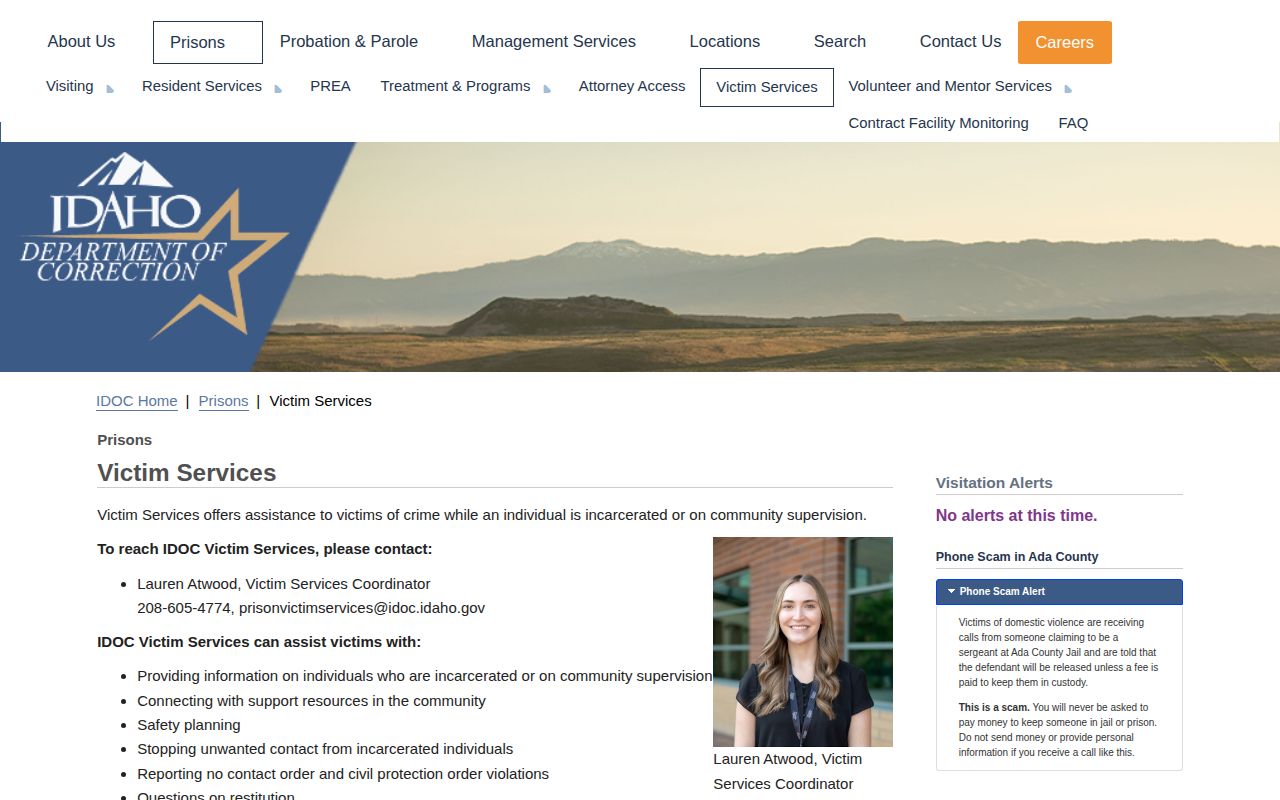
This source helps separate automated VINE alerts from notices maintained directly by IDOC Victim Services.
Boise Release Check Alternatives
A failed VINELink search is not evidence that the person was never held or has been released. Coverage may not include the agency, identity input may not match, or the source update may be pending. Follow the custody path rather than repeatedly broadening a name search.
Identity checks are especially important in a one-person notification search. Compare the complete name, middle initial, birth year or date when available, and the source-system number. IDOC warns that one person may have more than one IDOC number, so review each plausible state result and its sentencing county. Do not combine a Boise County court case with a VINE subject from another county merely because the names match. If the official interface permits a shorter spelling search, use it only to find candidates, then return to stronger identifiers before registering.
For a Boise County arrest, ask Boise County Sheriff's Office where the person was transported. Its main line is 208-392-4411. If Ada County Jail accepted the booking, Ada's current roster and custody line address the current episode, while an ACSO records request can establish admission, movement, release time, release type, and receiving agency. BCSO Records, at 208-392-6059, requires a specific written request and can address locally held arrest or transport material. These offices can own different parts of the same event.
For a felony prison case, the IDOC record is the source for custody, community supervision, and discharge status. A Commission hearing schedule or decision may explain a planned parole action, but a tentative parole date remains conditional. Compare it with later IDOC “In community” and “Released to Supervision” data. For legal authority, use the Boise County iCourt case. A docket may show a bond, judgment, dismissal, or order, yet the custodian's record remains necessary to prove the actual exit.
Federal and immigration cases stay separate. Search a federally sentenced person through the BOP locator. Search ICE custody through the Online Detainee Locator System, which covers current custody and only a limited post-release window. Neither result should be merged with a VINE event. State the narrow conclusion that the evidence supports, such as “released from Ada County Jail” or “released to IDOC supervision.”
Keep a small verification note for any consequential release check. Record the date and time searched, state selected, agency selected, name or nonpublic identifier used, source timestamp, displayed status, and event date. If a phone call resolves the key point, note the office and the exact nonconfidential fact confirmed. Seek the written record when release time, authority, or destination matters. This practice prevents an old alert or cached status from being presented as current.
Notification choices also require upkeep. A changed phone number or blocked email can defeat an otherwise correct registration. Review contact details in the subject record when the service permits it, and use the Idaho VINE help number for account or PIN assistance. The four-digit phone PIN acknowledges the notice; it does not verify the subject's identity or certify the release outcome.
Note: Preserve the source agency's exact custody wording when destination remains unknown.